Managed IT Services for AEC Firms: Building Resilience, Security, and Operational Stability
Architecture, engineering, and construction (AEC) firms operate in one of the most demanding technology environments of any industry. Projects are deadline-driven, collaboration is distributed, compliance expectations are increasing, and failure, whether operational or security-related, can expose major technology risks with immediate financial and reputational impact.
Many firms continue to rely primarily on internal IT full-time employees (FTEs) to manage this complexity. While internal resources bring familiarity and proximity, the reality is that the scope of modern AEC technology needs has outgrown what any single individual, or even a small internal team, can realistically cover.
As a result, many firms are reevaluating how they approach managed IT services for AEC firms and whether a broader operational support model can better align with business demands.
Why Are Managed IT Services Important for AEC Firms?
AEC firms depend on constant uptime, secure collaboration, and reliable access to project data. Even short disruptions can impact deadlines, client relationships, and profitability.
Unlike many industries, AEC organizations often manage:
- Large design and modeling files
- Remote and hybrid project teams
- Multiple software platforms and integrations
- Compliance and cybersecurity requirements
- Tight project timelines with little room for downtime
Because of this complexity, managed IT services can provide more consistent coverage, specialized expertise, and operational continuity than a traditional one-person or small-team IT structure.
A Deep Bench of Specialized Talent—Not a Single Point of Failure
An internal IT FTE, regardless of experience, is often required to function as a generalist. One person may be expected to understand infrastructure, cloud platforms, cybersecurity, compliance frameworks, collaboration tools, end-user support, disaster recovery, and vendor management, all while responding to daily operational issues.
Managed IT services help reduce this dependency by providing access to specialists across multiple disciplines. This allows critical IT functions to be supported by professionals focused on specific areas of expertise rather than divided attention across every technology issue the organization faces.
This structure can also improve response times, reduce operational bottlenecks, and help firms scale technology support as business needs evolve.
What Risks Can Result from Relying on a Single Internal IT Resource?
One of the most underestimated risks of relying heavily on internal IT FTEs is knowledge concentration. Configuration decisions, system standards, passwords, vendor relationships, and infrastructure history can become dependent on a single individual’s undocumented knowledge.
Without centralized processes and documentation, the departure of a key IT employee can create operational blind spots that affect day-to-day performance in several ways:
- Delayed issue resolution
- Gaps in documentation
- Inconsistent system management
- Increased cybersecurity risk
- Operational disruption during transitions
Managed IT service models are typically designed around institutional knowledge. Environments are documented continuously, standards are enforced more consistently, and operational knowledge remains accessible regardless of staffing changes or business growth.
Availability That Matches AEC Reality
AEC work rarely operates on a fixed schedule. Critical issues can surface during evenings, weekends, proposal deadlines, or active project delivery periods.
To help support fast-moving project environments and reduce downtime risk, managed service models typically provide capabilities such as:
- Continuous monitoring
- Defined escalation paths
- Redundant support coverage
- Faster response capabilities
- Proactive maintenance and issue detection
This helps reduce the operational risk tied to a single individual’s availability and creates greater stability for firms managing multiple concurrent projects. See how Stambaugh Ness provided the Managed IT infrastructure that fueled regional expansion and multi-office growth for a Tampa architecture firm.
Security and Compliance Embedded into Operations
Cybersecurity and compliance expectations continue to increase across the AEC industry. Frameworks such as NIST and CMMC require ongoing monitoring, documentation, and enforcement—not just periodic reviews.
As cybersecurity expectations continue to rise, firms are prioritizing operational safeguards and compliance practices that strengthen resilience across the organization, including:
- Continuous security monitoring
- Multi-factor authentication management
- Backup and disaster recovery processes
- Access control and user management
- Compliance documentation and reporting
Embedding these processes into daily operations can help firms improve audit readiness, strengthen breach resilience, and reduce exposure to operational risk.
Strategic Technology Guidance That Supports Business Goals
Technology creates the most value when it directly supports business outcomes. For AEC firms, this often means improving project delivery, reducing downtime, supporting collaboration, strengthening security, and enabling scalable growth.
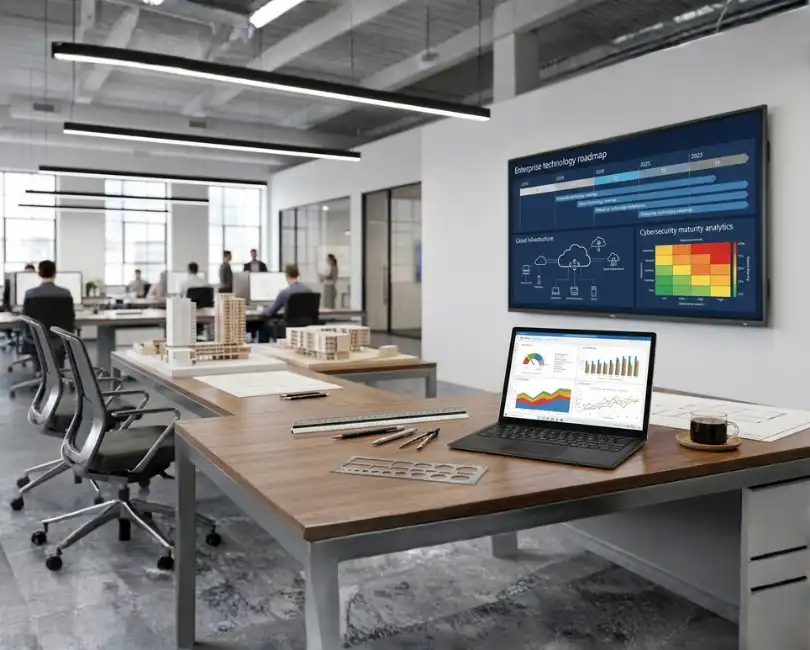
Beyond day-to-day technical support, many firms also look to managed IT partners for longer-term operational and infrastructure planning in areas such as:
- Technology planning
- Infrastructure modernization
- Cybersecurity strategy
- Vendor coordination
- Business continuity planning
- IT roadmap development
This allows firms to shift from reactive technology management toward a more proactive operational strategy.
M&A Readiness: An Often-Overlooked Advantage
Technology readiness can play an important role in mergers, acquisitions, and ownership transitions within the AEC industry.
During mergers and acquisitions, technology environments that are organized and consistently maintained can help support smoother diligence processes through:
- Clearer system documentation
- More consistent security practices
- Reduced operational risk
- Better visibility into infrastructure and assets
- Greater confidence in scalability and continuity
Preparation is not only defensive, it can also strengthen positioning and reduce surprises during transactions.
Explore What an AEC-Focused Managed IT Strategy Could Look Like
Technology challenges in the AEC industry are rarely one-size-fits-all. From cybersecurity and compliance to infrastructure scalability and project continuity, firms benefit from support models built around the realities of how AEC businesses operate.
Because Stambaugh Ness focuses exclusively on the architecture, engineering, and construction industry, our team understands the operational, security, and technology pressures firms face every day. If you’d like to explore how managed IT services can help strengthen your firm’s technology environment, reduce risk, and support long-term growth, connect with our team to start the conversation.